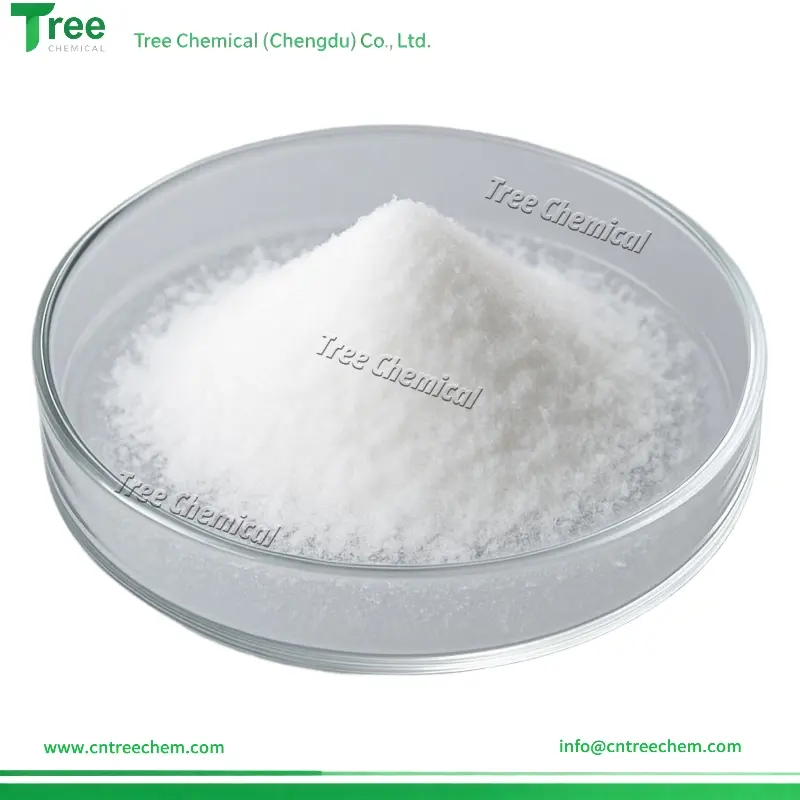


1-Methylpyrrole NMPy N-Methylpyrrole CAS 96-54-8
- CAS: 96-54-8
- Synonyms: 1-Methylpyrrole; N-Methylpyrrole; 1-Methyl-1H-pyrrole; NMPy
- EINECS No.: 202-513-7
- Molecular Formula: C₅H₇N
- Grade: Superior / First / Qualified
- Packaging: 25 kg or 200 kg drum
Tree Chem 1-Methylpyrrole (NMPy) is a nitrogen-containing five-membered ring compound with aromatic characteristics, offering both electrophilic and nucleophilic reactivity. Produced via selective methylation of pyrrole under controlled conditions, the product features low moisture, low color value, and minimal oxidation byproducts.
We manufacture and supply NMPy for API intermediates, conductive polymers, dye chemistry, and specialty chemical synthesis, ensuring stable supply and quality consistency. For inquiries, please reach out at info@cntreechem.com.
Specification
Basic Information
| Parameter | Value |
| Product Name | 1-Methylpyrrole |
| Abbreviation | NMPy |
| CAS No. | 96-54-8 |
| EINECS No. | 202-513-7 |
| Molecular Formula | C₅H₇N |
| Molecular Weight | 81.12 |
| Appearance | Colorless to slightly yellow transparent liquid |
| Synonyms | N-Methylpyrrole; 1-Methyl-1H-pyrrole; N-Methyl-2,5-dihydropyrrole; NMPy |
| Packaging | 25 kg drum / 200 kg drum |
Technical Specification
| Item | Superior Grade | First Grade | Qualified Grade |
| 1-Methylpyrrole (wt%) ≥ | 99.5 | 99.0 | 98.5 |
| Water (wt%) ≤ | 0.02 | 0.05 | 0.10 |
| Color (Hazen, Pt-Co) ≤ | 20 | 30 | 50 |
| 1-Methylpyrrole Oxide (wt%) ≤ | 0.01 | 0.02 | 0.05 |
Applications
Pharmaceutical Industry
- 1-Methylpyrrole serves as a key intermediate in pharmaceutical synthesis, widely used in the preparation of anti-inflammatory, antibiotic, antidepressant, antihistamine, and cardiovascular drugs.
- In non-steroidal anti-inflammatory drug (NSAID) production, 1-Methylpyrrole participates in the synthesis of Tolmetin. It first reacts with chloroacetyl chloride to form N-methyl-2-chloroacetyl pyrrole, which then undergoes cyclization and hydrolysis to yield Tolmetin with high yield and stability. This route is industrially mature and ensures strong anti-inflammatory performance.
- In antibiotic manufacture, 1-Methylpyrrole is involved in the synthesis of Cefepime, a fourth-generation cephalosporin that offers broad-spectrum antibacterial activity. The pyrrole ring contributes to the molecule’s stability and wide antibacterial spectrum.
- In antidepressant synthesis, 1-Methylpyrrole provides the essential heterocyclic fragment for selective serotonin reuptake inhibitors such as Sertraline, Fluoxetine, and Paroxetine, ensuring reliable molecular integrity in the synthetic sequence.
- Additionally, 1-Methylpyrrole is applied in the preparation of antihistamines like Loratadine and Cetirizine, as well as in the design of anticancer, antimalarial, and cardiovascular therapeutic intermediates, extending its influence across diverse drug categories.
- Beyond intermediates, 1-Methylpyrrole is also a versatile solvent and carrier in formulations. It enhances drug solubility, acts as a co-solvent in injectable preparations, and improves skin permeability in transdermal delivery systems. Typical transdermal patches contain 5–15 % active ingredient, 30–50 % adhesive, and 3–20 % 1-Methylpyrrole, optimizing diffusion through the stratum corneum and maintaining controlled release performance.
Agrochemical Industry
- In agrochemical synthesis, 1-Methylpyrrole functions as an essential intermediate for modern herbicides, insecticides, and fungicides. It is particularly significant in the creation of new arylpyrrolidone-based herbicides such as Dimepyrolimet, where the 1-Methylpyrrole moiety constructs a core structural segment of the active compound.
- During the key alkylation and ring-closure reactions, 1-Methylpyrrole contributes to molecular stability and efficient synthesis of selective herbicides exhibiting low toxicity and high field performance.
- It is also used in the production of neonicotinoid insecticides such as Imidacloprid and Thiacloprid derivatives, as well as in multifunctional pesticide molecules that exhibit both insecticidal and fungicidal effects. In addition, 1-Methylpyrrole plays roles in the development of plant growth regulators and acaricides, expanding its agrochemical portfolio.
- In formulation technology, 1-Methylpyrrole acts as a solvent and stabilizing carrier. In emulsifiable concentrate (EC) systems, it is typically used at 0.5–10 % alongside 10–60 % technical material, 30–60 % organic solvent, and 5–15 % emulsifier. In suspension concentrate (SC) systems, its 0.1–5 % presence enhances dispersibility and prevents sedimentation. In microemulsion (ME) systems, a 5–15 % dosage supports active ingredient dissolution and long-term stability.
Lithium-Ion Battery Industry
- 1-Methylpyrrole and its ionic derivatives are key additives and monomers for next-generation lithium-ion battery electrolytes.
- Its derivatives such as Pyr13TFSI, Pyr14TFSI, and P12TFSI function as ionic-liquid components with wide electrochemical windows exceeding 5 V and excellent thermal stability. They allow safe operation across –20 °C to 80 °C and enable over 700 charge-discharge cycles with capacity retention above 94 %.
- In composite formulations, 1-Methylpyrrole acts as an additive that reduces aluminum corrosion, minimizes lithium loss, and increases Coulombic efficiency. Its inclusion in 0.5–8 % range improves ion mobility and film formation on electrode surfaces.
- In gel polymer electrolytes, 1-Methylpyrrole is combined with PVDF (15–25 %), ethylene carbonate and dimethyl carbonate (10–20 % each), and LiPF₆ (1 M) to yield ionic conductivities up to 10⁻³ S/cm and electrochemical windows around 4.5 V, ensuring compatibility with high-energy cells.
Coating and Ink Industry
- In coatings, 1-Methylpyrrole is valued for its excellent solvency toward various resins and its contribution to smooth film formation. It is widely used in epoxy, polyurethane, and polyimide coatings.
- Epoxy formulations typically include 60–70 % resin, 10–15 % curing agent, and 5–10 % 1-Methylpyrrole to improve adhesion and surface uniformity. Polyurethane coatings integrate 5–15 % of 1-Methylpyrrole to adjust viscosity and enhance gloss, while polyimide coatings use 10–20 % for thermal stability up to 200 °C.
- In the ink sector, 1-Methylpyrrole serves as a high-boiling solvent providing controlled evaporation and uniform pigment dispersion. It is used at 10–25 % in solvent-based inks and 10–30 % in UV-curable inks, where it accelerates curing and ensures print clarity. In specialized conductive or fluorescent inks, 1-Methylpyrrole acts as a medium for dispersion of functional fillers and as a component of photoresist strippers, improving cleaning efficiency without substrate damage.
Flavor and Fragrance Industry
- 1-Methylpyrrole is a valuable raw material and solvent in flavor and fragrance synthesis. Its derivatives, especially 2-acetyl-1-methylpyrrole, provide a characteristic roasted-coffee aroma.
- It is used in 0.1–5 % levels in compound fragrances for meat, fruit, and smoky notes, and in perfumery it enhances persistence and warmth. In tobacco flavoring, 1-Methylpyrrole improves mouthfeel and reduces harshness, contributing to smoother taste perception. It also functions as a solvent in blending operations for food-grade and personal-care essences.
Electronic and Functional Materials
- In electronic chemicals, 1-Methylpyrrole is used in semiconductor cleaning and photoresist removal solutions, where its purity exceeds 99.99 % and metallic ions are controlled to ppb levels. Compositions containing 15–25 % 1-Methylpyrrole, 30–40 % alcohols, and 30–40 % deionized water effectively remove flux residues without corrosion.
- It is also a precursor for conductive polypyrrole materials used in anti-corrosion coatings, sensors, and supercapacitors. Through oxidative polymerization, 1-Methylpyrrole forms a conjugated network with conductivity ranging from 10 to 50 S/cm, serving as a core component in energy-storage and electronic devices.
- In biodegradable materials, its derivatives are utilized to synthesize biocompatible polymers such as poly(α-acetyl-γ-butyrolactone), which can be used for medical implants and gradually absorbed in the human body without secondary surgery.
Storage & Handling
- Store in a cool, dry, and ventilated environment away from sunlight and open flame.
- Keep containers sealed and moisture-free to prevent oxidation or discoloration.
- Avoid contact with strong oxidizers and acids.
- Recommended storage temperature: below 30 °C.
- Use steel or polyethylene drums for storage and transportation.
Usage Notice
- Operate in a well-ventilated area and avoid inhaling vapors.
- Wear protective gloves, goggles, and anti-static clothing.
- Prevent contact with eyes or skin; rinse immediately with clean water if contact occurs.
- Dispose of waste according to local environmental regulations.
- Avoid prolonged exposure to air to prevent formation of peroxides or oxidized impurities.
- In Tolmetin synthesis, 100 g of 1-Methylpyrrole reacts with 120 g chloroacetyl chloride and 110 g triethylamine in 500 mL dichloromethane at 0–5 °C for 2 hours, yielding 85–90 %.
- In the ring-closure step of Tolmetin intermediate preparation, N-methyl-2-chloroacetyl pyrrole (100 g) reacts with 2-amino-5-methylthiazole (85 g) and K₂CO₃ (120 g) in DMF at 80–90 °C for 6 hours to achieve 75–80 % yield.
- In Cefepime intermediate synthesis, 1-Methylpyrrole provides the nitrogen heterocycle structure that ensures stability and bioactivity of the final cephalosporin.
- In antidepressant synthesis, 10–30 mol % 1-Methylpyrrole is combined with formaldehyde and catalysts to form key amine intermediates for Sertraline and Fluoxetine.
- In transdermal patch systems, 5–15 % active drug, 30–50 % adhesive, and 3–20 % 1-Methylpyrrole are blended to enhance skin permeability and drug release efficiency.
- In Dimepyrolimet herbicide synthesis, 100 g 1-Methylpyrrole, 120 g 3,5-dimethylbenzaldehyde, and 150 g K₂CO₃ react in 500 mL DMF at 100–110 °C for 8 hours to yield 70–75 %.
- In the subsequent acylation stage, the alkylation product (100 g) reacts with 95 g 5-chloro-1-methyl-1H-pyrazole-4-carboxylic acid and 110 g triethylamine in 400 mL dichloromethane at room temperature for 12 hours, yielding 65–70 %.
- In pesticide EC formulations, 10–60 % active ingredient, 30–60 % solvent, 0.5–10 % 1-Methylpyrrole, and 5–15 % emulsifier are mixed to improve solubility and emulsion stability.
- In ionic-liquid electrolytes, Pyr14TFSI (64–80 %), Li-salt (12–27 %), and 1-Methylpyrrole additive (0.5–8 %) are combined to enhance conductivity and thermal stability.
- In gel polymer electrolytes, PVDF (15–25 %), N-Methylpyrrole (30–50 %), carbonate solvents (10–20 %), and LiPF₆ (1 M) form a membrane with ionic conductivity of 10⁻³ S/cm.
- In epoxy coatings, 60–70 % resin, 10–15 % curing agent, and 5–10 % 1-Methylpyrrole are blended to improve film adhesion and surface leveling.
- In polyurethane coatings, 50–60 % resin, 10–15 % curing agent, and 5–15 % 1-Methylpyrrole are mixed to enhance gloss and flow control.
- In solvent-based ink, 15–25 % pigment, 20–30 % resin, and 10–25 % 1-Methylpyrrole are combined with solvent to achieve stable dispersion and high-definition printing.
- In UV-curable ink, the blend of prepolymer, photoinitiator, and 10–30 % 1-Methylpyrrole ensures rapid curing within 1 second and superior film smoothness.
- In photoresist stripper formulations, 20–75 % NMP, 35–40 % γ-butyrolactone, and small quantities of 1-Methylpyrrole remove > 95 % organic residues without substrate damage.
- In flavor formulations, 85–90 % aroma base, 5–10 % 1-Methylpyrrole, and 1–3 % fixative are mixed to enhance aroma diffusion and stability.
Packaging
- 25 kg drum
- 200 kg drum
- Custom packaging available upon request