



Methyl Tributyl Ammonium Chloride MTBAC Tributylmethylammonium Chloride CAS 56375-79-2
- CAS: 56375-79-2
- Synonyms: Tributylmethylammonium chloride; Methyl tributyl ammonium chloride; MTBAC
- EINECS No.: 260-135-8
- Molecular Formula: C13H30ClN
- Grade: Industrial grade
- Packaging: 25 kg fiber drum
Tree Chem supplies methyl tributyl ammonium chloride (CAS 56375-79-2) for customers looking to purchase quaternary ammonium salts for catalytic and separation applications. The product is commonly applied in phase transfer reactions, organic synthesis, and specialty chemical formulations where efficient ion transport is required.
As a manufacturer and supply partner, Tree Chem provides methyl tributyl ammonium chloride with stable composition and clear specification control. The product is suitable for research use and scale-up production. For more information, please contact info@cntreechem.com.
Specification
Basic Information
| Item | Description |
| Product Name | Methyl Tributyl Ammonium Chloride |
| CAS No. | 56375-79-2 |
| Synonyms | Tributylmethylammonium chloride; Methyl tributyl ammonium chloride |
| Molecular Formula | C13H30ClN |
| Molecular Weight | 235.84 |
| EINECS No. | 260-135-8 |
Technical Specification
| Item | Specification |
| Appearance | Colorless to pale yellow liquid or solid (depending on temperature) |
| Assay | ≥ 99.0% |
| Water Content | ≤ 1.0% |
Applications
Introduction and Functional Profile
- Methyl tributyl ammonium chloride (MTBAC) is a quaternary ammonium salt that is used across multiple industrial chains because MTBAC combines ionic character with a hydrophobic cation structure.
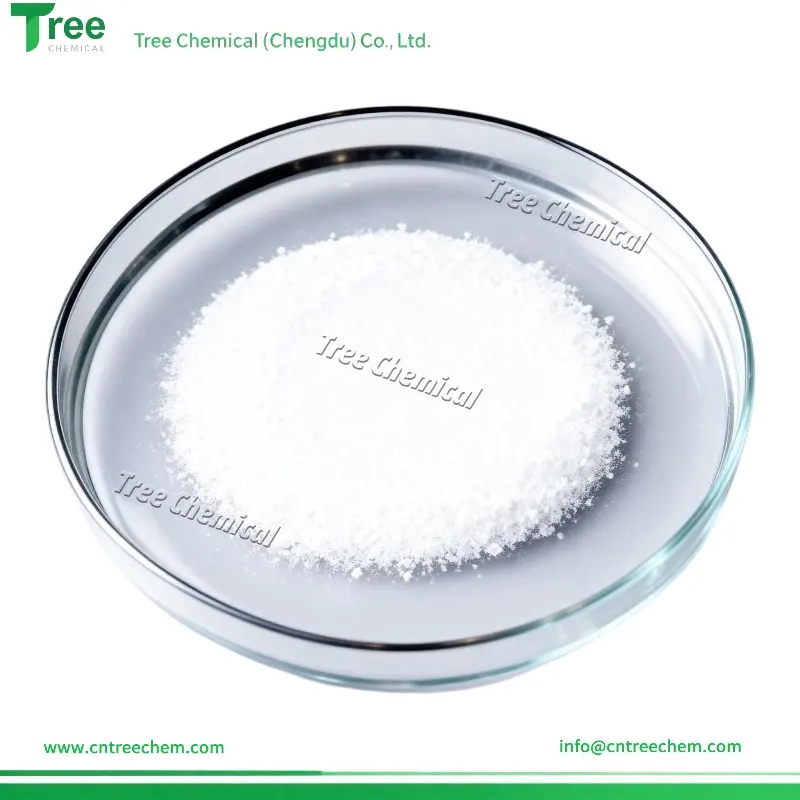
- MTBAC is typically handled as a white to off-white crystalline powder or as a colorless to yellowish liquid depending on grade and water content, and MTBAC tends to absorb moisture due to its hygroscopic nature.
- MTBAC shows good solubility in water and ethanol, and MTBAC is generally not compatible with nonpolar solvent systems such as acetone, chloroform, or diethyl ether in typical use conditions.
- MTBAC is selected in process design when MTBAC is expected to act as a phase transfer catalyst, and MTBAC is also chosen when MTBAC is expected to contribute surfactant behavior, ionic-liquid precursor utility, or electrolyte performance.
Organic Synthesis and Pharmaceutical Manufacturing
- MTBAC is widely applied as a phase transfer catalyst because MTBAC enables reactions to proceed efficiently when reactants are distributed between aqueous and organic phases.
- MTBAC is used to move anionic species from the aqueous phase into the organic phase, and MTBAC helps improve reaction rate and conversion under milder operating conditions than many alternative approaches.
- MTBAC is commonly used in nucleophilic substitution routes, and MTBAC supports efficient manufacture of substituted products when MTBAC is present at molar-percent catalyst levels.
- MTBAC is often paired with aqueous bases or nucleophiles, and MTBAC helps reduce the need for strictly anhydrous operations in many practical synthesis settings.
- MTBAC is also described for esterification and acetylation related synthesis routes, and MTBAC is applied when MTBAC can provide catalytic support within defined temperature and time windows.
- MTBAC is used as a catalytic component in certain acetylation concepts discussed in the document, and MTBAC is positioned as a useful helper for pharmaceutical intermediate chemistry where MTBAC improves practicality.
- MTBAC appears in antibiotic intermediate synthesis scenarios, and MTBAC is used to facilitate coupling steps where MTBAC supports contact between hydrophilic and hydrophobic reaction partners.
- MTBAC is included in process concepts for β-lactam related intermediates, and MTBAC is associated with high-yield performance in the example framework presented for MTBAC use.
- MTBAC is also referenced in platinum-complex intermediate preparation, and MTBAC is used when MTBAC improves solubility and mass transfer for ligand substitution steps.
- MTBAC is positioned as a helper for efficiency in such metal complex preparation routes, and MTBAC is included at higher catalyst loading in the example outline provided for MTBAC.
Catalysis Beyond Classic Phase Transfer Use
- MTBAC is presented as useful in cyclization chemistry, and MTBAC supports multi-step pathways where MTBAC assists intermediate transport between phases.
- MTBAC is included in an indole-related synthesis example, and MTBAC is described as improving the feasibility of the transformation when MTBAC is used at molar-percent levels.
- MTBAC is also described for polymerization-related use, and MTBAC is applied when MTBAC can influence kinetics and molecular weight distribution in specialty polymer production.
- MTBAC is framed as a catalyst or stabilizing contributor in an acrylic polymerization context, and MTBAC is used at low percentage ranges when MTBAC is used for this purpose.
Energy Storage and Advanced Electrolytes
- MTBAC is described as a component in lithium-ion battery electrolyte concepts, and MTBAC is included because MTBAC can enhance ionic conductivity and contribute to electrode interphase behavior.
- MTBAC is positioned as a performance modifier in LiPF₆ carbonate electrolyte systems, and MTBAC is discussed as improving cycling stability and rate performance when MTBAC is present in controlled proportions.
- MTBAC is also discussed for high-temperature electrolyte concepts, and MTBAC is included because MTBAC can contribute thermal stability to the electrolyte formulation.
- MTBAC is linked to enabling operation at elevated temperatures in the formulation outline, and MTBAC is presented as part of a package with other additives in that scenario.
- MTBAC is further discussed in supercapacitor electrolyte systems, and MTBAC is used as a supporting electrolyte or electrolyte salt when MTBAC concentration is selected for the desired conductivity and voltage window.
- MTBAC is presented for both aqueous and organic supercapacitor concepts, and MTBAC is positioned to support high cycling durability when MTBAC is used appropriately.
- MTBAC is described in redox-flow battery electrolyte concepts, and MTBAC is included as a supporting electrolyte to improve stability and reduce crossover behavior in the described framework.
- MTBAC is also described in gel and solid-state electrolyte concepts, and MTBAC is incorporated because MTBAC can raise ionic conductivity while the polymer matrix maintains mechanical integrity.
Electronics and Semiconductor Processing
- MTBAC is described for semiconductor post-etch cleaning formulations, and MTBAC is used because MTBAC helps remove organic residues while maintaining surface integrity in the described process window.
- MTBAC is included at low weight percentages in the cleaning solution concept, and MTBAC is paired with alkaline and oxidizing components in the described MTBAC cleaning framework.
- MTBAC is also described for photoresist stripping concepts, and MTBAC is included at higher weight percentages where MTBAC functions as a stripping agent component in the formulation outline.
- MTBAC is discussed in combination with strong polar solvents and water, and MTBAC is positioned for effective resist removal with controlled substrate impact.
- MTBAC is presented as an electroplating additive in precious metal plating, and MTBAC is used to support brightness, leveling, and conductivity behavior in the described bath concepts.
- MTBAC is highlighted for gold plating and palladium plating formulations, and MTBAC is described as a surface-adsorbing additive that influences deposit morphology when MTBAC is dosed in mg/L ranges.
- MTBAC is also described for electronic material synthesis and processing, and MTBAC is used as a dopant or processing aid in conducting polymer synthesis contexts.
- MTBAC is further described as a trace additive for organic semiconductor film formation, and MTBAC is positioned as improving morphology and reducing defects when MTBAC is used at very low levels.
Analytical Chemistry and Instrumental Methods
- MTBAC is described as an ion-pairing reagent in chromatographic methods, and MTBAC is used to enable separation of ionic or highly polar analytes in reversed-phase systems.
- MTBAC is presented for HPLC mobile phase concepts, and MTBAC is combined with buffering salts and organic modifiers in the outlined MTBAC method composition.
- MTBAC is also discussed for oligonucleotide analysis, and MTBAC is positioned as a key ion-pairing component for ion-pair reversed-phase chromatography when MTBAC concentration and temperature are selected as described.
- MTBAC is additionally described for mass spectrometry sample preparation, and MTBAC is used to improve ionization behavior and reduce problematic adduct patterns in the outlined MTBAC approach.
- MTBAC is presented as a supporting electrolyte in electrochemical analysis, and MTBAC is used in solvent systems to provide stability and a wide electrochemical window under the described conditions.
- MTBAC is positioned for cyclic voltammetry and related methods, and MTBAC is included as an electrolyte salt at typical supporting-electrolyte concentrations.
Polymers, Materials Science, and Surface Engineering
- MTBAC is described for cellulose processing concepts, and MTBAC is combined with a co-solvent system to enable cellulose dissolution under the described temperature and time profile.
- MTBAC is positioned as an enabling dissolution agent in the stated MTBAC solvent approach, and MTBAC is associated with improved processing efficiency in the described MTBAC system.
- MTBAC is also described for polymer electrolyte preparation, and MTBAC is incorporated into polymer matrices where MTBAC provides ionic conduction.
- MTBAC is discussed as a conductivity contributor in solid polymer electrolyte concepts, and MTBAC is presented with defined weight percentage ranges in the described MTBAC example.
- MTBAC is described for metal surface treatment formulations, and MTBAC is included because MTBAC can contribute corrosion inhibition behavior within the outlined aqueous system concept.
- MTBAC is also described for polymer surface functionalization, and MTBAC is used as a catalyst component that supports grafting and improved wettability and adhesion when MTBAC is formulated as described.
- MTBAC is presented for nanocomposite and dispersion use, and MTBAC is used as a surfactant or dispersing aid for carbon nanotube suspensions in the described MTBAC dispersion framework.
- MTBAC is also described as a structure-directing agent for ceramic nanoparticle synthesis, and MTBAC is positioned to influence particle size and morphology when MTBAC is included at defined ratios.
- MTBAC is described for adhesives and coatings, and MTBAC is used as a curing accelerator or processing aid in epoxy and pressure-sensitive adhesive concepts.
- MTBAC is positioned as a low-dosage additive that improves flow and adhesion behavior, and MTBAC is paired with standard resin and hardener systems in the described MTBAC formulations.
Environmental, Water Treatment, and Pollution Control
- MTBAC is described for heavy metal recovery and extraction from wastewater, and MTBAC is used as an extractant component where MTBAC supports transfer and recovery efficiency in the described system.
- MTBAC is also described for organic pollutant removal concepts, and MTBAC is used as a phase transfer catalyst in advanced oxidation frameworks where MTBAC helps improve contact between phases.
- MTBAC is discussed for cyanide destruction in wastewater, and MTBAC is included as a catalyst in an oxidation approach where MTBAC supports rapid conversion under the described pH and temperature window.
- MTBAC is additionally described for oil and water separation, and MTBAC is used as a demulsifier at ppm-level dosing where MTBAC supports emulsion breaking performance.
- MTBAC is described for air pollution control concepts, and MTBAC is used to enhance absorption and mass transfer in alkaline scrubbing solutions where MTBAC functions as a phase transfer and wetting-support contributor.
- MTBAC is also described for bioremediation support via soil washing concepts, and MTBAC is used as a surfactant component that increases solubility and bioavailability of hydrophobic contaminants in the described MTBAC process.
Oil and Gas Field Chemistry
- MTBAC is described as a drilling fluid additive, and MTBAC is used as a shale inhibitor and lubricant contributor in the described drilling mud concept.
- MTBAC is positioned to reduce clay hydration and swelling, and MTBAC is included with other inhibitors to support drilling fluid stability when MTBAC is formulated as described.
- MTBAC is also described for enhanced oil recovery formulations, and MTBAC is used as a surfactant component that helps reduce interfacial tension in chemical flooding concepts.
- MTBAC is positioned to improve displacement efficiency in the described EOR framework, and MTBAC is paired with polymers and salinity control elements in the MTBAC formulation outline.
Textile Processing and Finishing
- MTBAC is described as a dyeing auxiliary for synthetic fibers, and MTBAC is used to improve leveling and dye penetration behavior in the described dyeing system.
- MTBAC is included with pH control and temperature control elements, and MTBAC is positioned to improve uniformity and fastness when MTBAC is used in the described process.
- MTBAC is also described for textile finishing, and MTBAC is used as a softening and antistatic active where MTBAC adsorbs on fiber surfaces to provide durable effects in the described MTBAC formulation.
- MTBAC is combined with oils and emulsification systems, and MTBAC is positioned as a main active ingredient in the described MTBAC softener concept.
Food-Related Equipment Cleaning and Contact-Surface Compatibility
- MTBAC is described as used in cleaning formulations for food processing equipment, and MTBAC is included because MTBAC can emulsify soils and support removal of fatty and proteinaceous residues in the described CIP framework.
- MTBAC is positioned as compatible with food contact cleaning compound requirements in the described concept, and MTBAC is paired with alkaline cleaners and chelating components in the outlined MTBAC cleaning system.
Personal Care and Cosmetics
- MTBAC is described for hair care conditioning formulations, and MTBAC is used as a conditioning agent and viscosity-support contributor in the described MTBAC conditioner concept.
- MTBAC is combined with fatty alcohols, acids, humectants, and water, and MTBAC is positioned to improve combability and conditioning performance when MTBAC is formulated as described.
Paper Coating and Process Aids
- MTBAC is described for paper coating formulations, and MTBAC is used as a dispersing agent that supports pigment distribution and coating uniformity in the described MTBAC coating concept.
- MTBAC is combined with pigments, starch binders, and polymer additives, and MTBAC is positioned to reduce coating defects and improve printability when MTBAC is used at low parts-by-weight levels.
Safety, Handling, and Storage Context
- MTBAC is described as requiring appropriate PPE and disciplined handling, and MTBAC is positioned as causing irritation hazards that make MTBAC protective measures necessary in routine work.
- MTBAC is described as moisture-sensitive in storage, and MTBAC is kept tightly sealed to preserve quality because MTBAC readily absorbs water from the environment.
- MTBAC is described as stored in cool, dry, ventilated conditions away from heat and direct sunlight, and MTBAC storage practices are designed to reduce degradation risk and exposure risk.
- MTBAC is described with spill response and first aid frameworks, and MTBAC handling guidance emphasizes ventilation, dust control, hygiene, and compliant disposal practices.
Market Outlook and Emerging Directions
- MTBAC is described as having steady market growth drivers, and MTBAC demand is linked to increased use in pharmaceutical synthesis, electronics chemical applications, energy storage, and advanced materials.
- MTBAC is described with regional supply and production characteristics in the document, and MTBAC is positioned as a widely produced specialty chemical with scalable capacity.
- MTBAC is also described for emerging application exploration, and MTBAC is presented as investigated for perovskite solar cells, printable materials, biomedical coating concepts, and carbon capture related directions.
- MTBAC is positioned as a multi-role chemical that can be adapted by anion exchange to create ionic liquid variants, and MTBAC is described as a practical precursor for tailored property design.
Storage & Handling
- Store in tightly sealed containers in a cool, dry, and well-ventilated area
- Avoid exposure to heat, moisture, and direct sunlight
- Keep away from strong oxidizing agents
- Ensure containers and transfer equipment are clean and dry
- Follow standard industrial chemical handling procedures
Usage Notice
- This product is intended for industrial and professional use only. Users should conduct suitability testing before large-scale application.
- Appropriate personal protective equipment should be used during handling, and all local safety regulations must be followed.
- Formulation: Organic nucleophilic substitution system using an organic substrate with an aqueous nucleophile source and MTBAC at molar-percent catalyst loading in an organic solvent under moderate heat; Function: MTBAC transfers anionic reactants across phases to accelerate substitution and improve conversion under practical conditions.
- Formulation: Esterification or acetylation synthesis setup using carboxylic acid and alcohol with MTBAC as a catalyst component in the specified temperature window; Function: MTBAC supports catalytic efficiency and improves feasibility for intermediate manufacturing routes.
- Formulation: Antibiotic intermediate coupling concept combining the core intermediate, an acylating agent, aqueous buffer base, organic solvent, and MTBAC as the phase transfer catalyst at molar-percent level; Function: MTBAC improves contact between hydrophilic and hydrophobic reactants to support high-yield coupling.
- Formulation: Platinum complex intermediate preparation using a platinum precursor in aqueous medium with an amine ligand and MTBAC at higher catalyst loading under elevated temperature operation; Function: MTBAC improves solubility and mass transfer to enhance ligand substitution efficiency.
- Formulation: Lithium-ion battery electrolyte concept using LiPF₆ in carbonate solvents with MTBAC as a small-percentage conductivity and interphase modifier; Function: MTBAC enhances ionic transport and supports interphase behavior for improved cycling stability in the described framework.
- Formulation: High-temperature lithium-ion electrolyte concept using LiPF₆ with MTBAC and a film-forming additive in mixed carbonate solvents; Function: MTBAC contributes thermal stability and helps maintain performance at elevated operating temperatures in the described concept.
- Formulation: Aqueous supercapacitor electrolyte concept using MTBAC at high molarity with supporting acid and water balance; Function: MTBAC provides supporting electrolyte conductivity to enable stable high-cycle operation within the described voltage window.
- Formulation: Organic supercapacitor electrolyte concept using MTBAC with a co-electrolyte salt in acetonitrile as the main solvent; Function: MTBAC acts as an electrolyte salt to support high-voltage operation in the described system.
- Formulation: Semiconductor post-etch cleaning solution using MTBAC at low percentage with ammonium hydroxide, hydrogen peroxide, and deionized water operated at controlled temperature and time; Function: MTBAC helps remove organic residues while maintaining wafer surface integrity in the described process.
- Formulation: Photoresist stripping formulation using MTBAC at higher percentage with a strong solvent system and water plus a trace surfactant; Function: MTBAC supports resist removal performance with controlled substrate impact in the described stripping window.
- Formulation: Precious metal electroplating bath using metal salt source with MTBAC dosed at mg/L range alongside complexing and buffering agents under controlled pH and temperature; Function: MTBAC acts as a brightener and leveling additive that influences deposit morphology and bath conductivity.
- Formulation: Reversed-phase HPLC ion-pair mobile phase using MTBAC at millimolar concentration with buffering salt and organic modifier at controlled pH; Function: MTBAC provides ion-pairing behavior to enable separation of ionic and highly polar analytes.
- Formulation: Oligonucleotide ion-pair chromatography system using MTBAC with a stronger buffer and organic phase at elevated column temperature; Function: MTBAC enables ion-pair retention control and resolution for nucleic acid fragment separation.
- Formulation: Electrochemical analysis electrolyte using MTBAC at typical supporting-electrolyte concentration in acetonitrile with a co-solvent fraction; Function: MTBAC provides ionic conductivity and a stable background for wide-window voltammetry measurements.
- Formulation: Cellulose dissolution concept using MTBAC with DMSO as co-solvent and cellulose feed under controlled heating and residence time; Function: MTBAC acts as a dissolution-enabling component to support cellulose processing in the described system.
- Formulation: Metal surface treatment aqueous formulation using MTBAC with corrosion inhibitor and coupling agent components at low percentage; Function: MTBAC contributes corrosion inhibition and treatment performance within the described protective system.
- Formulation: Cyanide oxidation wastewater treatment concept using MTBAC with sodium hypochlorite under alkaline pH control and moderate temperature; Function: MTBAC catalyzes oxidation efficiency to support rapid cyanide destruction in the described process.
Packaging
- 25 kg fiber drum
- Packaging can be arranged according to customer requirements.


