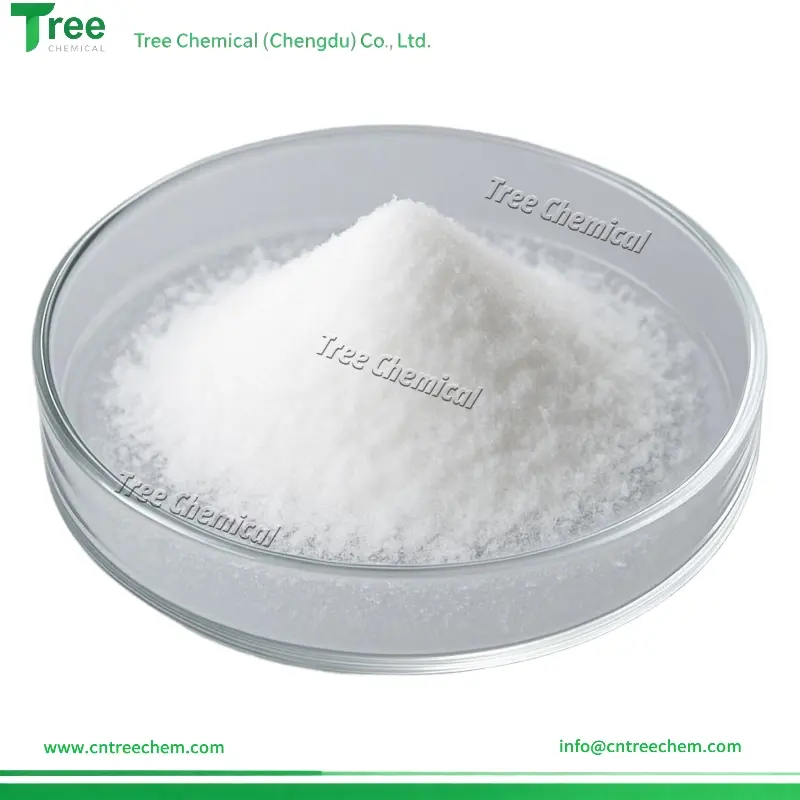


Methyl triphenyl phosphonium Bromide CAS 1779-49-3
- CAS: 6865-35-6
- EINECS: 229-966-3
- Molecular Formula: (C₁₈H₃₅O₂)₂Ba
- Synonyms: Barium distearate; Octadecanoic acid barium salt; BaSt₂
- Grade: Grade I / Grade II / Grade III
- Packaging: 20 kg/bag, 400 kg/jumbo bag, customizable
Tree Chem supplies methyltriphenylphosphonium bromide (CAS 1779-49-3), a phosphonium salt commonly used to generate phosphorus ylides in organic synthesis, supporting alkene formation via Wittig and related reactions.
This product is suitable for use in pharmaceutical intermediates, fine chemical synthesis, and research laboratories. Tree Chem provides flexible supply and packaging options based on customer requirements. For technical details or ordering information, please contact info@cntreechem.com.
Specification
Basic Information
| Item | Details |
| Product Name | Methyltriphenylphosphonium Bromide |
| CAS No. | 1779-49-3 |
| Synonyms | Triphenylmethylphosphonium bromide; Methyltriphenylphosphonium bromide |
| Molecular Formula | C₁₉H₁₈BrP |
| Molecular Weight | 357.22 |
| EINECS No. | 217-218-9 |
Technical Specification
| Item | Specification |
| Appearance | White to off-white crystalline powder |
| Assay | ≥98.0% |
| Moisture | ≤0.5% |
| Melting Point | 245–250 °C (decomp.) |
Applications
Wittig Olefination and General Organic Synthesis
- Methyltriphenylphosphonium bromide is primarily used as the precursor to methylene triphenylphosphorane, a classic Wittig reagent that enables methylenation of carbonyl compounds to form terminal alkenes. In practical synthesis work, this role matters because the salt is converted in situ to the ylide under strong base, creating a reliable pathway to install a terminal double bond with predictable outcomes across many substrates.
- In process-oriented routes, methyltriphenylphosphonium bromide is often selected when a clean methylenation step is required as an intermediate “platform reaction” to unlock downstream transformations. It is especially relevant in multi-step sequences where the alkene product is later diversified through functionalization or ring-forming chemistry.
Pharmaceutical Intermediates and Medicinal Chemistry Building Blocks
- In pharmaceutical intermediate synthesis, methyltriphenylphosphonium bromide supports olefination steps used to assemble key motifs such as enyne systems, which can then be advanced through ring-closing strategies to deliver larger ring scaffolds. This makes the material valuable in medicinal chemistry contexts where scaffold construction and late-stage structural tuning are both important.
- The document also describes its use in building substituted polycyclic and aromatic derivatives through ylide-based olefination under suitable deprotonation conditions. In these workflows, the compound’s role is not merely “a reagent,” but a practical method to generate a reactive carbon nucleophile equivalent for forming C=C bonds in a controlled, scalable manner.
Phase-Transfer Catalysis in Biphasic Transformations
- Beyond Wittig chemistry, methyltriphenylphosphonium bromide is described as a phase-transfer catalyst in reactions where ionic reagents must react efficiently with organic substrates across two phases. Its lipophilic phosphonium cation helps shuttle reactive species and improve mass transfer, which can translate into faster reaction rates and improved conversions.
- This phase-transfer function is useful in fine-chemical manufacturing where aqueous salts or ionic nucleophiles are involved, but the desired reaction pathway takes place predominantly in the organic phase. It can also support operational simplicity by reducing the need for specialty solubilizers or extreme conditions in certain biphasic setups.
Powder Coatings and Heat-Resistant Coating Cure Catalysis
- In polymer materials, methyltriphenylphosphonium bromide is used as a cure catalyst in polyester-based powder coatings, especially in heat-resistant coating designs. In such formulations, it is applied at low parts-per-weight loading to promote controlled crosslinking during bake, helping achieve stable cure, strong film properties, and performance retention at elevated temperatures.
- The document outlines a heat-resistant powder coating framework where methyltriphenylphosphonium bromide can be used alone or alongside other catalyst options, integrated with heat-resistance modifiers and mineral fillers. This positions it as a practical catalyst choice for coatings used on heat-exposed hardware and industrial components.
Epoxy Resin Curing and One-Component System Design
- Methyltriphenylphosphonium bromide is discussed as a curing-related component for epoxy systems, particularly when controlled cure kinetics and improved shelf life are desired. Its thermal stability supports formulation into storage-stable systems that can remain workable until heat activation, which is relevant for one-component epoxy approaches.
- In epoxy formulation strategy, this role is valuable where traditional catalysts may cure too quickly, reduce storage stability, or create narrow processing windows. The compound’s function is therefore tied to balancing latency, cure efficiency, and manufacturability.
Deep Eutectic Solvents for Extraction and Fuel Purification
- The document highlights methyltriphenylphosphonium bromide as a hydrogen bond acceptor used to form deep eutectic solvents when combined with hydrogen bond donors in defined molar ratios. These eutectic systems are positioned as functional solvent media for extraction-focused operations, including fuel treatment processes.
- In particular, the described eutectic solvent systems are associated with extractive desulfurization and related upgrading tasks, where solvent performance and recyclability are central practical considerations. This places methyltriphenylphosphonium bromide into “green solvent” development workflows rather than only traditional synthesis.
Metal Extraction, Separation, and Environmental/Waste Streams
- Methyltriphenylphosphonium bromide–based solvent systems are also described for metal extraction from aqueous solutions, leveraging the phosphonium cation’s ability to support selective transfer behaviors in extraction processes. The document references applications connected to challenging streams, including radioactive-waste-related separation contexts.
- This application is process-driven: the compound is used to design an extraction medium that improves selectivity, reduces operational complexity, or provides an alternative to conventional organic solvent extraction routes. It broadens the compound’s relevance into hydrometallurgy-adjacent and environmental separation technologies.
Organic Electronics and Semiconductor-Adjacent Materials
- The document points to emerging exploration of methyltriphenylphosphonium bromide in organic electronics, including roles connected to charge-transport behavior in organic semiconductor device concepts. In this context, the compound is treated less like a classical reagent and more like a functional ionic material whose structure can influence device performance.
- This positioning suggests use in advanced materials R&D where ionic components are screened for their interfacial behavior, stability, and compatibility with solution-processing approaches. It extends the compound’s downstream value into electronics materials development.
Molecular Probes and Analytical Chemistry
- Methyltriphenylphosphonium bromide is also described as a molecular probe component in analytical methods, including resonance light scattering techniques used for determination of specific analytes in pharmaceutical-related contexts. Here, the compound is used to enable measurable signal changes tied to analyte interaction.
- This analytical role is application-focused in quality control and method development environments, where robustness, sensitivity, and repeatable signal behavior are required. It also complements the compound’s broader use in labs that combine synthesis with analytical verification.
Commercial Supply, Scale, and Application-Driven Quality Segmentation
- The document describes a market landscape where methyltriphenylphosphonium bromide is supplied across research and industrial channels, with application-driven segmentation by purity level and packaging scale. This reflects the reality that synthesis, coatings, solvent systems, and materials applications can impose different impurity and handling expectations.
- From a downstream perspective, the compound is positioned as both a laboratory staple for ylide chemistry and a scalable industrial auxiliary for coatings and extraction media, with pricing and availability shaped by grade and volume requirements.
Storage & Handling
- Store in tightly sealed containers in a cool, dry, and well-ventilated area
- Protect from moisture and prolonged exposure to air
- Avoid contact with strong oxidizing agents
- Use appropriate personal protective equipment during handling
Usage Notice
- This product is intended for professional use in chemical synthesis and research applications only.
- Ensure all equipment is clean and dry before use to avoid moisture-related degradation.
- Avoid prolonged exposure to air and humidity during weighing and transfer operations.
- Compatibility and reaction conditions should be verified by the user prior to large-scale application.
- Follow applicable safety regulations and laboratory handling procedures during use.
- A Wittig methylenation system can combine methyltriphenylphosphonium bromide in approximately equimolar ratio with a strong base in THF at low temperature followed by addition of a ketone substrate to generate the ylide in situ and convert the carbonyl compound into the corresponding terminal alkene.
- A general methylenation workflow can use methyltriphenylphosphonium bromide with an organolithium or strong alkoxide base under inert atmosphere in an aprotic solvent, then introduce the aldehyde or ketone to drive olefination and deliver an alkene intermediate for downstream functionalization.
- A phase-transfer catalysis setup can use methyltriphenylphosphonium bromide at low mol% in a biphasic organic–aqueous system to shuttle ionic reagents into the organic phase and accelerate transformations limited by phase separation and ion availability.
- A heat-resistant polyester powder coating can include hydroxyl-functional polyester resin with a uretdione curing agent and methyltriphenylphosphonium bromide at low parts-by-weight loading as a cure catalyst, then be melt-blended, milled, electrostatically sprayed, and baked to form a high-temperature durable film.
- A heat-resistant powder coating variant can formulate methyltriphenylphosphonium bromide alongside silicone resin, mineral fillers, pigments, and flow-control additives to promote controlled crosslinking during cure while improving heat resistance and film integrity.
- A one-component epoxy formulation can incorporate methyltriphenylphosphonium bromide as a latent curing-related component to extend storage stability and provide controlled cure kinetics when activated by heat in manufacturing or assembly processes.
- A deep eutectic solvent can be prepared by mixing methyltriphenylphosphonium bromide with a hydrogen bond donor such as glycerol or ethylene glycol at a defined molar ratio to form a stable eutectic medium used for extraction, catalysis, or solvent-based separations.
- A fuel upgrading eutectic solvent can blend methyltriphenylphosphonium bromide with polyol-type hydrogen bond donors at specified ratios to create a recyclable extraction medium that targets sulfur-containing compounds in extractive desulfurization applications.
- A metal extraction medium can be designed using methyltriphenylphosphonium bromide–based eutectic solvents or extraction phases to improve partitioning of metal species from aqueous solutions and support separation workflows for complex industrial or waste-derived streams.
- An organic electronics screening formulation can use methyltriphenylphosphonium bromide as an ionic material component in solution-processing studies to evaluate charge-transport or interfacial behavior in organic semiconductor device development.
- An analytical probe method can apply methyltriphenylphosphonium bromide in a resonance light scattering assay to enable quantification of target analytes through measurable signal changes under controlled reagent ratios and solution conditions.
- A storage and handling approach can keep methyltriphenylphosphonium bromide sealed in a cool, dry, well-ventilated environment with moisture protection and separation from oxidizing agents to maintain powder flowability and stable performance in synthesis and formulation use.
Packaging
- Customer-specified packaging
- Common options available upon request
- Suitable for laboratory and industrial logistics