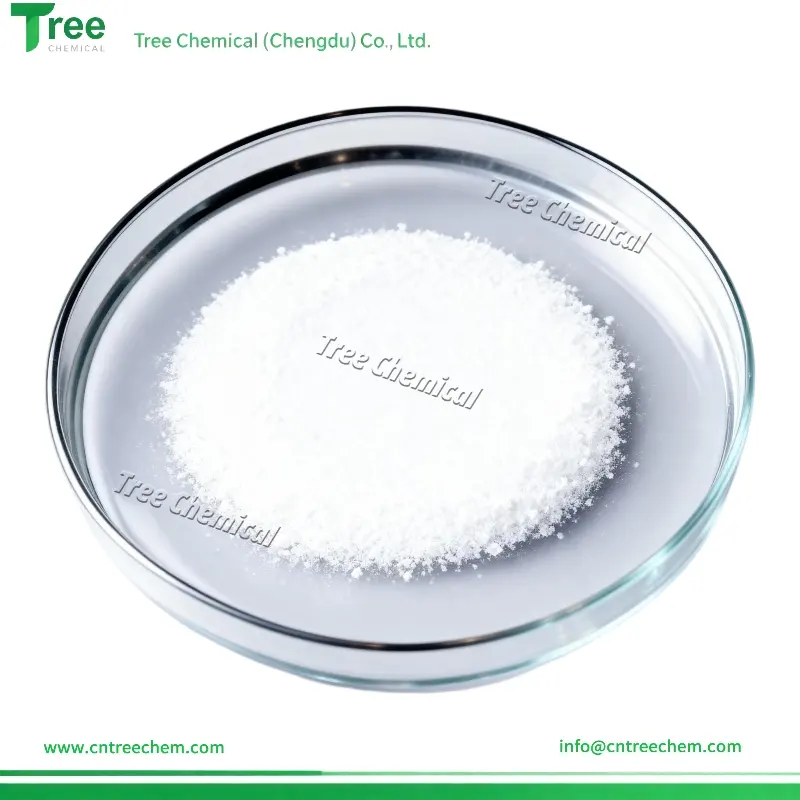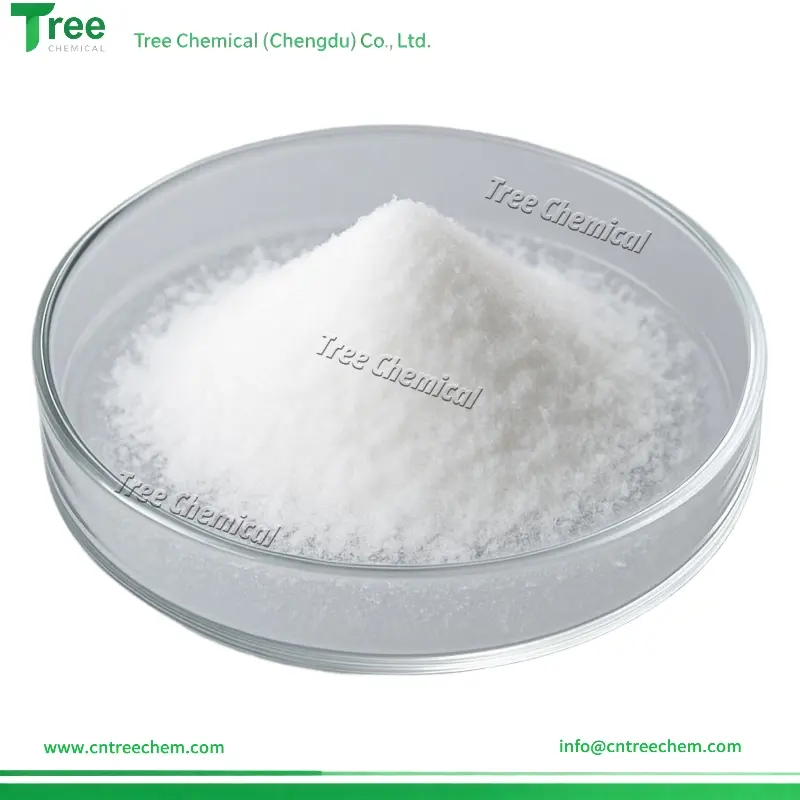


Tetraphenyl phosphonium Bromide TPPB Phosphonium, tetraphenyl-, bromide CAS 2751-90-8
- CAS: 2751-90-8
- Synonyms: Tetraphenylphosphonium Bromide; TTPB
- EINECS No.: 220-393-4
- Molecular Formula: C24H20BrP
- Grade: Reagent / Industrial grade
- Packaging: As specified by customer
Tree Chem supplies Tetraphenylphosphonium Bromide CAS 2751-90-8 for customers looking to purchase a stable phosphonium salt suitable for organic synthesis, catalytic systems, and specialty chemical applications. This product is typically used to enhance reaction efficiency by facilitating ion transfer between immiscible phases.
Tetraphenylphosphonium Bromide is commonly applied in pharmaceutical intermediates, fine chemicals, and research laboratories where controlled reactivity and purity are required. Tree Chem supports customer-specific packaging and supply arrangements to meet diverse application needs. For further information, please contact info@cntreechem.com.
Specification
Basic Information
| Item | Information |
| Product Name | Tetraphenylphosphonium Bromide |
| Synonyms | Tetraphenylphosphonium Bromide; TTPB; Phosphonium, tetraphenyl-, bromide |
| CAS No. | 2751-90-8 |
| Molecular Formula | C24H20BrP |
| Molecular Weight | 419.29 |
| EINECS No. | 220-393-4 |
Technical Specification
| Item | Specification |
| Appearance | White to off-white crystalline powder |
| Assay (%) | ≥ 97.0 |
| Loss on Drying (%) | ≤ 0.5 |
| Insoluble Matter | Passes test |
Applications
Phase-Transfer Catalysis in Pharmaceutical and Fine Chemical Synthesis
- Tetraphenylphosphonium bromide (TPPBr) is widely used as a phase-transfer catalyst in organic synthesis, helping reactions proceed efficiently when reagents sit in immiscible phases (typically an organic phase and an aqueous or inorganic-salt phase). In these processes, TPPBr acts as a “bridge” that transfers reactive ions into the organic phase, accelerating conversions that would otherwise be slow, incomplete, or operationally difficult.
- A typical example described in the file is oxazolidinone-related intermediate synthesis where TPPBr is used at low mol% loading to catalyze the coupling between isocyanates and epoxides under elevated temperature in common organic solvents. In production practice, this role is valued for improving reaction rate and enabling scalable workflows, especially when the process must balance conversion, selectivity, and manageable workup.
- TPPBr is also discussed as a practical catalyst option in broader fine-chemical manufacturing where inorganic nucleophiles or salts need to participate in organic-phase transformations. This makes it relevant for multi-step intermediate routes where phase behavior and mass transfer are major bottlenecks.
Fluorination and Fluoroaromatic Intermediate Preparation
- TPPBr is used as part of catalyst systems for fluorination reactions that convert nitroaromatic substrates into fluoroaromatic products using potassium fluoride. In these setups, TPPBr supports ion transport and activation within polar aprotic solvent environments, enabling efficient nucleophilic fluorination pathways.
- The file highlights fluorobenzaldehyde-type synthesis in which TPPBr is combined with an auxiliary complexing agent (such as crown ether or PEG-based complexing media) to enhance fluoride availability and reaction performance. In practical formulation design, this approach is selected when high yield and consistent conversion are required in a process that is otherwise limited by fluoride solubility and reactivity.
- Because fluorinated intermediates are common building blocks in pharmaceuticals and specialty materials, TPPBr’s role here extends beyond a single reaction—its value is tied to improving feasibility and throughput for a class of fluorination processes.
Metal Extraction, Separation, and Purification
- TPPBr is used in liquid–liquid extraction to remove or separate metal species from aqueous streams by forming ion-association complexes that preferentially partition into an organic phase. This approach is applied to metals present as complex anions in acidic solutions, where extraction efficiency depends strongly on phase composition and ion-pair formation strength.
- The document notes use cases including extraction of heavy metals and removal of technetium from radioactive waste-related streams. Operationally, TPPBr is formulated at meaningful molar concentrations in chlorinated organic solvents, mixed for defined contact times, then separated by phase disengagement, offering a controllable pathway for metal transfer.
- In downstream purification workflows, this application is attractive when the target metal exists in a stable anionic form and conventional precipitation routes are slow, non-selective, or generate high secondary waste loads.
Fluoroelastomer (FKM) Processing: Accelerator and Adhesion-Promoter Roles
- TPPBr is used in fluoroelastomer compounding as an accelerator and adhesion promoter that supports controlled curing behavior and improved processing stability. In FKM systems, it is introduced at phr-level dosing to adjust reactivity while maintaining good latency, helping compounds remain workable and stable before molding or vulcanization.
- In addition to cure control, the file emphasizes practical manufacturing benefits such as reduced mold fouling and improved adhesion to substrates or other elastomers. This is particularly relevant for molded parts where surface quality and release behavior impact cycle time, scrap rate, and cleaning frequency.
- TPPBr’s thermal stability and latency advantages are also highlighted versus alternative catalyst/accelerator families, making it suitable for FKM systems that operate at elevated temperatures and require long processing windows.
Polyacrylate Rubber (ACM) Curing Systems
- TPPBr functions as a curative in ACM rubber formulations, enabling curing packages designed for thermal stability and robust mechanical performance. In these systems, it is used with co-curatives (such as diamine or blocked diamine types) and typical fillers to build a controlled crosslink network.
- From a processing standpoint, TPPBr-based ACM systems are presented as offering long shelf life of uncured compounds, which is important for large-batch manufacturing, inventory management, and stable factory scheduling. This helps reduce the risk of premature scorch or viscosity drift during storage.
- Performance-side benefits mentioned include low compression set and anti-fouling tendencies, which are valued in seals, gaskets, and parts where long-term elasticity and cleanliness are required under heat and oil exposure.
Electrochemistry: Supporting Electrolyte for Electroreduction Systems
- TPPBr is used as a supporting electrolyte in electrochemical applications, where it improves ionic conductivity and stabilizes electrochemical environments in non-aqueous solvents. The file specifically discusses electroreduction contexts (including fullerene-related systems) where electrolyte selection is critical for reproducible voltammetry and controlled electron-transfer behavior.
- In practical laboratory and materials development work, TPPBr is chosen when a stable quaternary phosphonium electrolyte is preferred for compatibility with solvent systems and electrochemical windows. Its role here is less about “catalysis” and more about ensuring consistent charge transport and signal clarity.
- This application makes TPPBr relevant not only in academic research but also in development settings where electrochemical screening, mechanistic evaluation, or materials characterization is part of a broader product pipeline.
Polymer Solar Cells: Electron-Transport Layer Material
- TPPBr is described as an effective electron-transport layer (ETL) material in bulk heterojunction polymer solar cells, applied as a thin interfacial layer to improve device performance. In this context, TPPBr is deposited from dilute solution onto the active layer to tune interfacial energetics and enhance electron extraction.
- The file highlights measurable performance improvements when TPPBr-based ETLs are used compared with devices lacking the interlayer, and it also notes further enhancement when TPPBr is combined with an additional interfacial component in a binary mixture. These improvements are associated with more efficient charge transport and reduced interfacial losses.
- For device engineering, this positions TPPBr as a functional materials additive rather than a conventional reagent, expanding its relevance into electronics materials and energy-device manufacturing workflows.
Nanomaterials and Semiconductor Nanocrystal Synthesis
- TPPBr is used as a ligand in nanomaterial synthesis, supporting the formation of specific nanostructures by influencing nucleation, growth, and surface stabilization. The file provides an example in which TPPBr participates in hydrothermal routes for semiconductor nanostructures, paired with metal and sulfur sources.
- In such processes, ligand choice affects particle morphology, aggregation behavior, and reproducibility. TPPBr contributes to controlling these outcomes by interacting with developing crystal surfaces, helping guide the formation of targeted structures.
- This application matters for materials labs and downstream industries where nanostructure shape and surface chemistry directly influence optoelectronic properties, dispersion stability, and incorporation into composite systems.
Agrochemical and Dyestuff Synthesis: Phase-Transfer Facilitation
- TPPBr is used in agrochemical and dyestuff synthesis as a phase-transfer catalyst that enables reactions between organic substrates and inorganic reagents. These reaction classes often face phase limitations, where transferring an inorganic nucleophile into the organic phase is the main barrier to productivity.
- In practical manufacturing terms, this function can shorten reaction time, improve conversion, and expand feasible reagent choices. It is especially relevant for processes using common inorganic reagents that are otherwise poorly available in organic media.
- Because many agrochemical and colorant intermediates rely on stepwise transformations involving salts and polar reagents, TPPBr’s PTC role can be integrated across multiple steps rather than a single isolated reaction.
Analytical Chemistry and Laboratory Control
- TPPBr is used in analytical workflows, including titration-based determination methods that quantify bromide-associated salts via argentometric approaches. In a laboratory setting, this supports quality control of solutions or verification of reagent concentration during synthesis and formulation work.
- This role is practical in both research and production support labs where quick, classical analytical methods are used to confirm identity, concentration, or batch consistency without requiring complex instrumentation.
Storage & Handling
- Store in tightly sealed containers in a cool, dry place
- Protect from moisture and direct sunlight
- Avoid contact with strong oxidizing agents
- Handle using standard laboratory or industrial safety practices
Usage Notice
- Suitable for laboratory, pilot-scale, and industrial synthesis
- Recommended to perform compatibility testing before scale-up
- Use appropriate personal protective equipment during handling
- Oxazolidinone intermediate synthesis can use tetraphenylphosphonium bromide at about 0.1–1 mol% in toluene or DMF at roughly 80–120°C to act as a phase-transfer catalyst that accelerates the reaction between isocyanates and epoxides.
- Fluoroaromatic preparation can combine tetraphenylphosphonium bromide with potassium fluoride and a complexing aid such as 18-crown-6 or PEG dimethyl ether in acetonitrile or DMSO at about 80–150°C, using tetraphenylphosphonium bromide at roughly 5–10 mol% to enhance fluoride activation and conversion.
- Metal extraction can be performed by preparing an organic phase containing tetraphenylphosphonium bromide at about 0.1–0.5 M in chloroform or dichloromethane and contacting it with an acidic aqueous phase containing target metal anions at an approximate 1:1 phase ratio to form extractable ion-association complexes.
- FKM compounding can include fluoroelastomer gum at 100 phr with carbon black at about 20–40 phr, magnesium oxide at about 3–5 phr, bisphenol AF at about 2–4 phr, and tetraphenylphosphonium bromide at about 0.5–2 phr to function as an accelerator/adhesion promoter that improves processing stability and adhesion.
- ACM rubber curing can be designed with polyacrylate polymer at 100 phr, tetraphenylphosphonium bromide at about 1–3 phr, a diamine or blocked diamine co-curative at about 0.8–2 phr, filler at about 15–30 phr, and processing oil at about 5–10 phr to build a thermally stable cure system with long compound shelf life.
- Electroreduction electrolyte preparation can use tetraphenylphosphonium bromide at about 0.1–0.5 M in benzonitrile or dichloromethane with a substrate concentration in the low mM range, positioning tetraphenylphosphonium bromide as a supporting electrolyte for stable non-aqueous electrochemical operation.
- Polymer solar cell ETL deposition can use a tetraphenylphosphonium bromide solution around 0.5 mg/mL in methanol, spin-coated at about 3000 rpm for about 30 seconds to form a thin electron-transport layer before depositing the metal cathode.
- An ETL binary mixture approach can blend an additional interfacial component with tetraphenylphosphonium bromide at a defined weight ratio (as described in the file) to strengthen charge extraction and improve device performance compared with a single-layer interfacial design.
- Nanomaterial synthesis can use tetraphenylphosphonium bromide at about 0.05–0.1 M as a ligand together with a metal salt precursor around 0.1 M and a sulfur source around 0.1 M in ethylene glycol or water, processed hydrothermally at roughly 120–180°C for several hours to guide nanostructure formation.
- Agrochemical phase-transfer synthesis can run with tetraphenylphosphonium bromide at about 1–5 mol% in an organic solvent such as toluene or xylene while the inorganic reagent is supplied in an aqueous phase, using moderate temperatures (about 50–100°C) to accelerate biphasic transformations.
- Mohr titration-style analytical determination can titrate tetraphenylphosphonium bromide solutions with standardized silver nitrate using potassium chromate indicator, using the endpoint appearance to quantify bromide-associated concentration for laboratory control.
Packaging
- Supplied in customer-specified packaging formats
- Packaging options available upon request to meet laboratory or industrial requirements